News

Latest news and current events from around the world including special reports, entertainment news and exclusive video

Business

All the latest breaking business news from banking, stocks, currencies, funds and commodities to rice, garments and tourism

Download

Free downloads for Windows, Mac, iOS and Android computers and mobile devices. Every category of desktop software...

Life Style

Lifestyle is about the parts of our lives that are maybe a little more personal than everything else. It's how we make our homes, relate to our loved ones, raise our ...

Culture

The latest cultural news, criticism, including television, theatre, movies, music reviews, and Goings On About Town.

Health

Get energizing workout moves, healthy recipes, and advice on losing weight and feeling great...

Showing posts with label Economy. Show all posts

Tuesday, December 9, 2014

Black Friday bargain hunters help lift UK retailers out of usual November lull

Online spending went up by 37.5% from last year, while total retail sales up 2.2% against same time in 2013


Black Friday
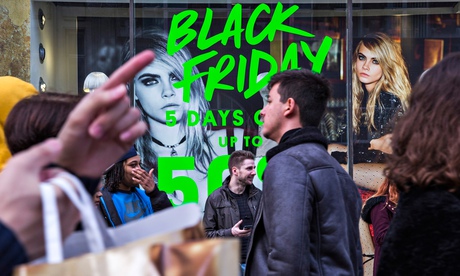
Originating in the USA as a sales day that following the Thanksgiving holiday, Black Friday is becoming an increasingly popular shopping day in the UK. Photograph: Rob Stothard/Getty Images
A Black Friday surge of spending by shoppers hunting for bargains online and in person gave all categories of retailing a boost last month.
The monthly snapshot of high street and internet consumer activity from the British Retail Consortium and KPMG found that the one-day promotional extravaganza lifted sales out of a normal November lull.

Barclaycard said Friday 21 November was the highest spending day on record, with online sales up by 37.5% on a year earlier. The BRC said internet shopping accounted for more than one pound in every five spent last month and that retailers whose online systems were found wanting had paid the price.

Helen Dickinson, the BRC director general, said: “November’s retail sales demonstrate continued growth in sales across the board compared with last month. The huge demand for bargain TVs and other household appliances on Black Friday, whether for personal use or as presents, meant that electrical items were the standout category in terms of sales growth.

“However, retailers also took advantage of the increased footfall generated by Black Friday to sell clothing, effectively bringing forward the start of Christmas sales reductions of autumn/winter stock.”

The squeeze on real incomes caused by prices rising faster than wages has meant consumers have taken a cautious approach during the autumn, with the unusually warm weather an additional problem for clothing and footwear retailers. Retailers are now hopeful that the strong start to the crucial Christmas and new year period will be sustained throughout.

Consumer spending power is growing thanks to falling inflation and the boost to disposable incomes provided by lower energy prices, which have resulted in higher household disposable incomes. The cost of Brent crude fell almost 4% on Monday to $66.50 – a fall of more than 40% since its peak in the summer.

The BRC said that once additional floor space had been taken into account, like-for-like sales were 0.9% higher last month than in November 2013. Total sales were 2.2% higher.

Household appliances – the sector in which Black Friday discounting was particularly aggressive – was the best-performing category, followed by furniture and the home categories.
Online sales of non-food products in the UK grew 12.0% in November against a year earlier and represented 21% of all non-food sales – the highest penetration since the BRC started to log internet sales in December 2012.

Dickinson said: “This month brings fantastic news for retailers who have worked hard on their online presence, as the online penetration rate of non-food sales is at an all-time record. Every £1 in £5 of non-food purchases is spent online. Online sales are also contributing a larger proportion of growth to non-food sales compared with in-store.”

Dickinson added that the high volume of traffic to websites meant that consumers also bought a large amount of full-priced items as well as those on sale. Online sales growth had been distorted by Black Friday, with consumers holding off from spending until the end of the month in the hope of grabbing a bargain.

David McCorquodale, head of retail at KPMG, said: “Consumers were reluctant to spend too much, too soon until a record-breaking Black Friday helped to kick-start festive spending. Fashion and footwear retailers used this occasion to recover some lost ground, but at a cost to their margin. Sales of electrical goods were strong all month and positively rocketed with Black Friday offers.
“Sadly, some retailers fell short of the mark, with websites crashing under the pressure of shoppers hunting for a bargain. Resolving these issues must be a priority: consumers go online to avoid queues, not join them.”

Barclaycard said consumers spent 18% more than they did on the same day last year to get hold of the best deals in the run-up to Christmas.

“Spending was up significantly online and in store as retailers offered discounts through both channels, but consumers increasingly took to the web to secure the best deals and avoid the crowds. Online spending was 37.5% higher than last year’s Black Friday, and the level of spending was up so much that it shifted the proportion of total online spending so far this season by 4 percentage points to 25.8%.”

Monday, December 8, 2014

China registers 92 million people in poverty


WUHAN, Dec. 6 (Xinhua) -- China has identified 128,000 impoverished villages and 92 million people living in poverty, said a senior poverty alleviation official on Saturday.

According to Liu Yongfu, head of the State Council leading group office of poverty alleviation and development, poverty has declined substantially in China, but the country still has 832 poor counties and districts
About 116,600 work teams with 466,000 cadres were dispatched to the villages for poverty alleviation, he told a seminar in central China's Hubei Province.

"Almost all underprivileged households have a cadre responsible for poverty alleviation work," he said.
He pointed out that more work should be done to improve people's lives in poor areas in all respects, including education, finance and housing.

He also disclosed that in 2015, China will help about 500 impoverished villages through tourism.
Li Jinzao, head of the China's national tourism administration who attended the seminar, said that China has so far lifted more than 8 million people out of poverty by developing tourism.

Along with overall GDP growth targets, the government is focusing on raising the income of the country's population with a current goal to double per capita income from the 2010 level by 2020. To expand the safety net for those in poverty, the national poverty line was increased from 206 yuan in 1986 to 2,300 yuan per annum in 2011 (33.5 to 374 U.S. dollars).

Friday, December 5, 2014

Uber’s value more than doubles to $40bn after investors back fundraising

Smartphone-driven taxi service six times larger than a year ago but has growing pains, says CEO

ubder-value-doubles-fundraising
Uber's smartphone-driven system has caused data security concerns. Photograph: Kai Pfaffenbach/REUTERS
Uber, the taxi service that allows users to hail a ride using their smartphone, has been valued at more than $40bn (£25.5bn) after its latest funding round.
The total is more than double the $18.2bn the company was said to be worth in June, when it raised $1.2bn from investors including Fidelity Investments and BlackRock.

Uber did not reveal who had put a further $1.2bn in the business. It already counts Goldman Sachs and Google Ventures as investors.

The latest valuation make the business worth more than listed companies such as the airline Delta ($37.4bn) and Kraft Foods ($35.4bn).

Only Facebook was valued higher as a private company – $50bn – by investors when it raised money ahead of floating on Nasdaq. The social network is now valued at almost $210bn.
Uber is not expected to become a public company for at least another 12 months.

Travis Kalanick, its co-founder and chief executive, said the new funding would allow the company to expand, particularly in the Asia-Pacific region.

He said in a blog post that Uber is now six times larger than it was 12 months ago, operating in more than 250 cities in 50 countries.

However, Kalanick admitted that the pace of expansion experienced by the company had resulted in “significant growing pains”.

He added: “The events of the recent weeks have shown us that we also need to invest in internal growth and change. Acknowledging mistakes and learning from them are the first steps.”
Uber has had to fight fires on a number of fronts this year, including negative stories about its corporate culture and the alleged behaviour of some of its drivers. One driver was charged in San Francisco with assaulting a customer in June.

It has also had to deal with attempts to limit its operations in a number of cities.
Last month the company apologised after a senior executive suggested the company hire a team of researchers to dig up dirt on hostile journalists.

The apology came in the same week that Al Franken, the television comedian turned Democrat senator and chairman of the Senate sub-committee on privacy, wrote to Kalanick asking Uber to explain how it dealt with users’ data.

Its employees are able to track customers because its smartphone app relies on GPS technology to connect users with drivers.

“The reports suggest a troubling disregard for customers’ privacy, including the need to protect their sensitive geolocation data,” Franken wrote. “Under what circumstances would an employee face discipline for a violation of Uber’s privacy policies?”
He gave Uber 28 days to respond to his questions. The company said it would do so and had instructed law firm Hogan Lovells to review its data privacy rules.

The San Francisco-based firm also said on Thursday that it had set up a software development team in Amsterdam, its international headquarters.

Conrad Whelan, Uber’s second employee and first engineer, said he had begun working with a team of 10 Dutch mobile software experts and hoped to expand that number to as many as 40 in the coming year.

US technology companies routinely complain about the difficulty of obtaining visas for foreign software engineers. Uber also faces competition from Silicon Valley giants such as Google and Facebook for talent.

Wednesday, November 26, 2014

US economy stronger than expected in third quarter

Surge in business and consumer spending drove the US economy to an annual growth rate of 3.9% between July and September, but there are still concerns over a slowdown


Shopping in New York
Shopping in New York. The buoyant expansion in the last two quarters has failed to push up average wages and still leaves the US economy operating at 4% below its capacity, according to the Congressional Budget Office. Photograph: Jewel Samad/AFP/Getty Images
US economic growth was stronger in the third quarter of the year than first estimated, indicating that the world’s largest economy bounced back vigorously from a shock contraction at the beginning of 2014.

A surge in business and consumer spending drove the US economy to an annual growth rate of 3.9% between July and September from the previous 3.5% estimate, according to Commerce Department figures.

Officials also revised housebuilding activity higher and said firms built bigger stock inventories, which analysts said was usually a sign of confidence that sales would continue their upward path. GDP was already expanding at a rate of 4.6% in the second quarter.

But the buoyant expansion in the last two quarters has failed to push up average wages and still leaves the US economy operating at 4% below its capacity, according to the Congressional Budget Office. The outlook for the rest of the year and 2015 was also dampened by downward revisions to export growth, which has suffered following a slowdown in China and a decline in global trade.

Signals from the US Federal Reserve that interest rates will start to rise next year have also pushed the value of the dollar higher against most currencies and made it more costly for domestic manufacturers to sell their goods abroad.

Chris Williamson, chief economist at financial data provider Markit, said: “There are signs that the pace of economic growth and job creation could moderate in the final quarter of the year, and possibly to a greater extent than many are currently anticipating.”

Williamson said the US was vulnerable to a bout of severe winter weather, which was chiefly to blame for the dip in output in the first quarter of the year, and could suffer as the eurozone continues to stagnate and global shocks pose a risk to a recovery of trade.

The OECD echoed those concerns over US growth in its latest economic outlook on Tuesday. US growth is projected to reach 2.2% in 2014 and around 3% in 2015 and 2016, according to the latest forecasts from the west’s leading economic thinktank. It said the US and UK would limit the slowdown in global growth to 3.3% in 2014 before better conditions allowed an acceleration to 3.7% in 2015 and 3.9% in 2016.

It said Britain’s economic recovery will continue into 2015 and 2016, driven by consumer spending and business investment.

The Paris-based organisation said high job creation had fuelled UK growth, which it forecasts will come in at 3% this year. The OECD is predicting growth of 2.7% in 2015 and 2.5% in 2016.
Bank of England forecasts also expect the UK to expand in 2015, but governor Mark Carney told MPs on the treasury select committee on Tuesday that global economic conditions had deteriorated in Europe and Japan, which threatens the pace of recovery.

“The geopolitical situation remains difficult and the combination of that suggests a heightened degree of external risk to the United Kingdom,” he said.
The OECD noted that UK export growth has been weak since the recession, pushing the current account deficit to close to 5% of GDP. It said exports could weaken further if eurozone growth comes in below expectations.

Wage growth – which has been unexpectedly weak in 2014 – should start to pick up, it said, adding: “Stimulating retraining and encouraging migration in occupations where shortages arise would reduce labour mismatches and support balanced growth through higher productivity.”

The OECD cautioned however that if productivity does not recover as expected, it could translate into weaker UK growth.

“Robust productivity is an essential condition for strong and sustainable growth, and uncertainty over its recovery is a major risk to the projection. Labour market pressures could disconnect real wage growth from productivity and lead to cost-push inflation.”

OIL TUMBLES: Here's What You Need To Know

The Dow and S&P 500 both slipped on Tuesday, ending their streak of record highs, while oil prices tumbled after reports ahead of Thursday's OPEC meeting gave a mixed view on whether the cartel would agree to production cuts.
First, the scoreboard:
  • Dow: 17,814.9, -3, (-0.02%)
  • S&P 500: 2,067, -2.4, (-0.1%)
  • Nasdaq: 4,758.2, +3.3, (+0.07%)
And now, the top stories on Tuesday:

1. The big story on Tuesday was oil. West Texas Intermediate crude futures fell to $74 on Tuesday, a decline of more than 2% or more than $1.80, after reports from Reuters early in the day said that officials from Saudi Arabia, Mexico, Russia, and Venezuela met ahead of Thursday's OPEC meeting with the sides not agreeing to cut oil production. A report from The Wall Street Journal said that at Thursday's meeting, Saudi Arabia will "likely side with calls for the group to adhere more closely to its self-imposed production ceiling," which the cartel hasn't been firm on since reaching a 30 million barrel per day production target three years ago. Some on Wall Street are expecting OPEC to announce a production cut as the organization tries to combat declining oil prices amid a global supply glut.

2. The first revision to third quarter GDP came in way better than expected on Tuesday morning, with the BEA's revision showing the US economy grew at a 3.9% annualized pace in the third quarter, better than the 3.5% initial reading and the 3.3% revised pace that was expected by Wall Street economists. 

3. We also got housing data from the S&P/Case-Shiller home price index, which showed home prices rose 0.34% in September, the first month-on-month increase since April. Expectations were for the report to show a 0.3% increase. 

4. Yale professor Robert Shiller, the Shiller half of the Case-Shiller index, appeared on CNBC following the latest release and noted that the futures market is currently expecting home prices to rise 5% a year over the next two years, which Shiller said seems reasonable. Shiller also talked a bit about the stock market, which according to his CAPE Shiller P/E ratio is historically expensive, but Shiller said he is still invested in the stock market. 

5. We also got consumer confidence data on Tuesday from The Conference Board, with November's report disappointing. The report showed consumer confidence fell to 88.7 in November, down from 94.5 last month, and widely missing expectations for a 96 reading. The Conference Board's Lynn Franco said following the report, "Consumer confidence retreated in November, primarily due to reduced optimism in the short-term outlook."
6. Apple hit a new all-time on Tuesday, and the iPhone maker's market cap crossed the $700 billion threshold for the first time. 

7. The latest household debt survey from the New York Federal Reserve showed that household debt rose to $11.71 trillion in the third quarter, up from $11.62 trillion the prior quarter. "Outstanding household debt, led by increases in auto loans, student loans and credit card balances, has steadily trended upward in recent quarters," said Wilbert van der Klaauw, senior vice president and economist at the New York Fed. Overall, household debt is below its $12.68 trillion peak reached in the third quarter of 2008.